
整理/李思 制圖/董怡璇
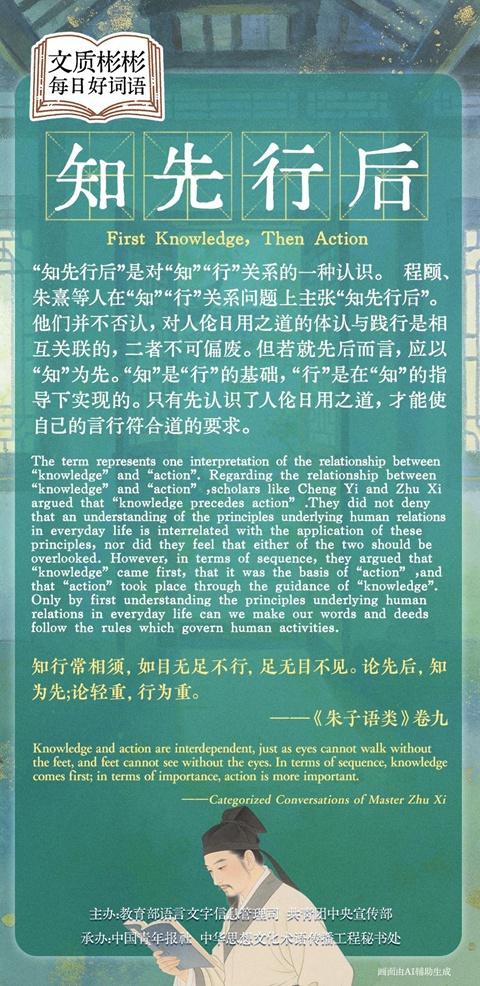
知先行后
“知先行后”是對“知”“行”關系的一種認識。程頤、朱熹等人在“知”“行”關系問題上主張“知先行后”。他們并不否認,對人倫日用之道的體認與踐行是相互關聯的,二者不可偏廢。但若就先后而言,應以“知”為先。“知”是“行”的基礎,“行”是在“知”的指導下實現的。只有先認識了人倫日用之道,才能使自己的言行符合道的要求。
First Knowledge, Then Action
The term represents one interpretation of the relationship between "knowledge" and "action." Regarding the relationship between "knowledge" and "action," scholars like Cheng Yi and Zhu Xi argued that "knowledge precedes action." They did not deny that an understanding of the principles underlying human relations in everyday life is interrelated with the application of these principles, nor did they feel that either of the two should be overlooked. However, in terms of sequence, they argued that "knowledge" came first, that it was the basis of "action," and that "action" took place through the guidance of "knowledge." Only by first understanding the principles underlying human relations in everyday life can we make our words and deeds follow the rules which govern human activities.
引例
知行常相須,如目無足不行,足無目不見。論先后,知為先;論輕重,行為重。(《朱子語類》卷九)(知與行始終是相互依存的,如同眼睛沒有足的功用不能前行,足沒有眼睛的功用則不能視路。若說二者先后,知在行先;若說二者輕重,行更重要。)
Knowledge and action are interdependent, just as eyes cannot walk without the feet, and feet cannot see without the eyes. In terms of sequence, knowledge comes first; in terms of importance, action is more important. (Categorized Conversations of Master Zhu Xi)

版權所有:中華人民共和國教育部 中文域名:教育部.政務
京ICP備10028400號-1 京公網安備11010202007625號 網站標識碼:bm05000001




