
整理/李思 制圖/董怡璇
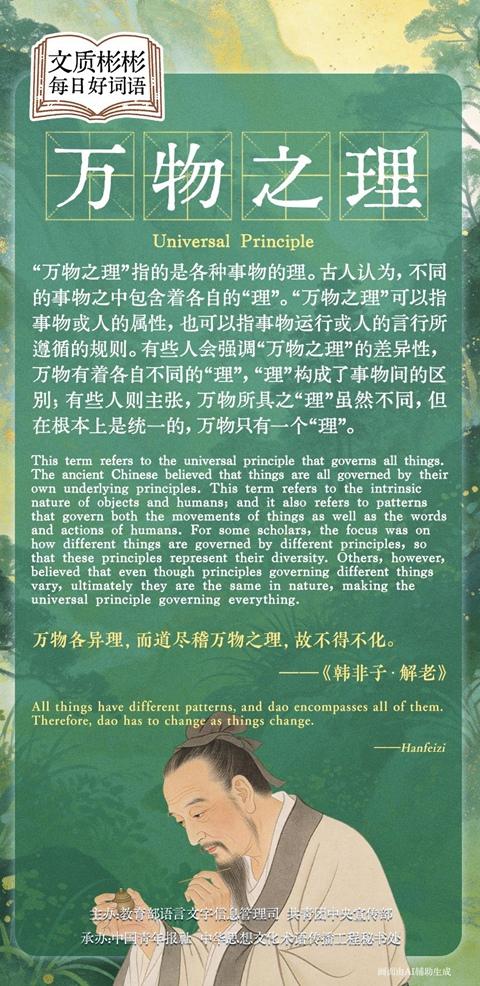
萬物之理
“萬物之理”指的是各種事物的理。古人認為,不同的事物之中包含著各自的“理”。“萬物之理”可以指事物或人的屬性,也可以指事物運行或人的言行所遵循的規則。有些人會強調“萬物之理”的差異性,萬物有著各自不同的“理”,“理”構成了事物間的區別;有些人則主張,萬物所具之“理”雖然不同,但在根本上是統一的,萬物只有一個“理”。
Universal Principle
This term refers to the universal principle that governs all things. The ancient Chinese believed that things are all governed by their own underlying principles. This term refers to the intrinsic nature of objects and humans; and it also refers to patterns that govern both the movements of things as well as the words and actions of humans. For some scholars, the focus was on how different things are governed by different principles, so that these principles represent their diversity. Others, however, believed that even though principles governing different things vary, ultimately they are the same in nature, making the universal principle governing everything.
引例
萬物各異理,而道盡稽萬物之理,故不得不化。(《韓非子·解老》)(萬物各自具有不同的理,而道會合所有事物的理,因此道不得不隨萬物而變化。)
版權所有:中華人民共和國教育部 中文域名:教育部.政務
京ICP備10028400號-1 京公網安備11010202007625號 網站標識碼:bm05000001




