
整理/李思 制圖/董怡璇
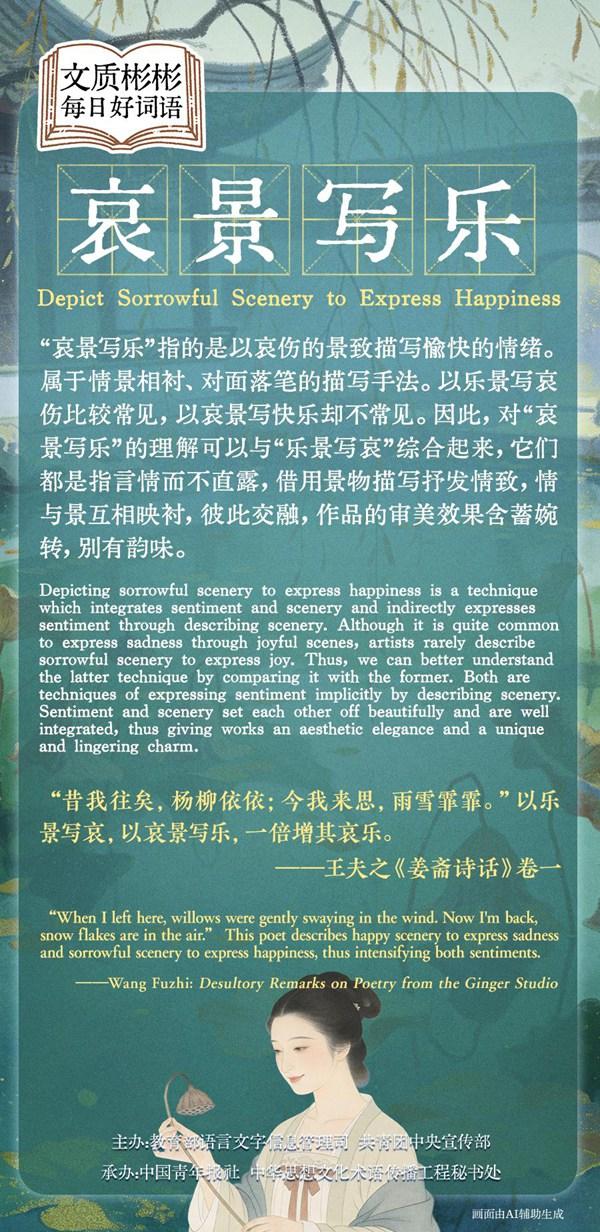
哀景寫樂
“哀景寫樂”指的是以哀傷的景致描寫愉快的情緒,屬于情景相襯、對面落筆的描寫手法。以樂景寫哀傷比較常見,以哀景寫快樂卻不常見。因此,對“哀景寫樂”的理解可以與“樂景寫哀”結合起來,它們都是指言情而不直露,借用景物描寫抒發情致,情與景互相映襯,彼此交融,作品的審美效果含蓄婉轉,別有韻味。
Depict Sorrowful Scenery to Express Happiness
Depicting sorrowful scenery to express happiness is a technique which integrates sentiment and scenery and indirectly expresses sentiment through describing scenery. Although it is quite common to express sadness through joyful scenes, artists rarely describe sorrowful scenery to express joy. Thus, we can better understand the latter technique by comparing it with the former. Both are techniques of expressing sentiment implicitly by describing scenery. Sentiment and scenery set each other off beautifully and are well integrated, thus giving works an aesthetic elegance and a unique and lingering charm.
引例
“昔我往矣,楊柳依依;今我來思,雨雪霏霏。”以樂景寫哀,以哀景寫樂,一倍增其哀樂。(王夫之《姜齋詩話》卷一)(“以前我離開,楊柳枝條輕柔飄拂;現在我歸來,大雪紛紛漫天飛舞。”以歡樂的景象寫哀傷,以悲哀的景象寫歡樂,更加增強了哀傷與歡樂的氣氛。)
"When I left here, willows were gently swaying in the wind. Now I'm back, snow flakes are in the air." This poet describes happy scenery to express sadness and sorrowful scenery to express happiness, thus intensifying both sentiments. (Wang Fuzhi: Desultory Remarks on Poetry from the Ginger Studio)

版權所有:中華人民共和國教育部 中文域名:教育部.政務
京ICP備10028400號-1 京公網安備11010202007625號 網站標識碼:bm05000001




