
整理/秦珍子 制圖/董怡璇
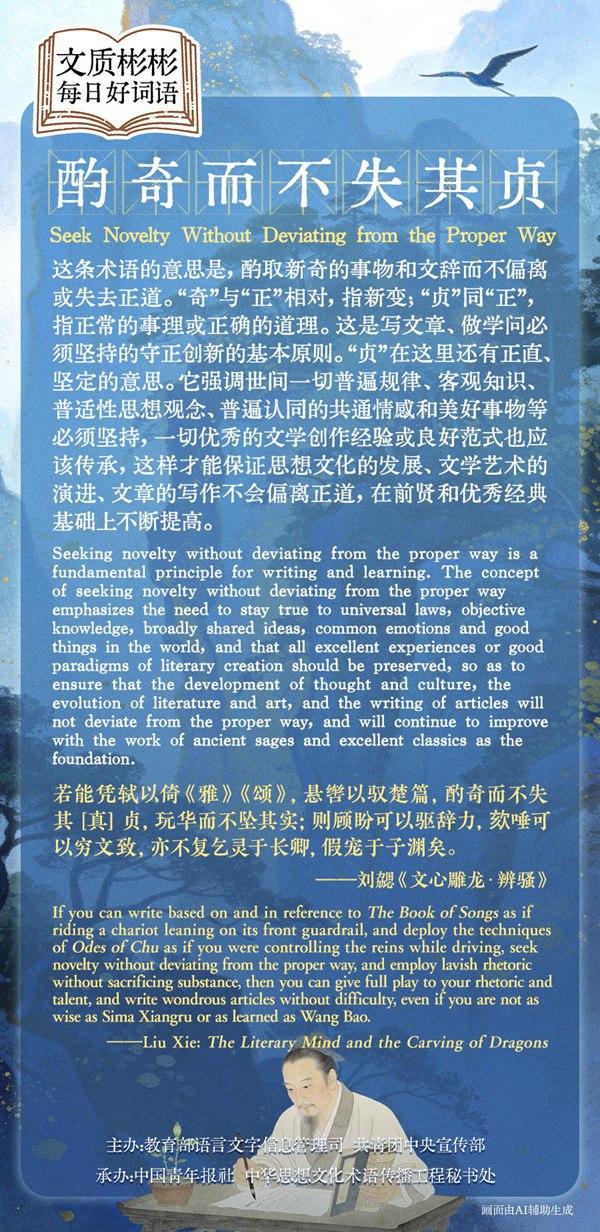
酌奇而不失其貞
酌取新奇的事物和文辭,而不偏離或失去正道。“奇”與“正”相對(duì),指新變;“貞”同“正”,指正常的事理或正確的道理。這是寫文章、做學(xué)問(wèn)必須堅(jiān)持守正創(chuàng)新的基本原則。“貞”在這里還有正直、堅(jiān)定的意思。它強(qiáng)調(diào)世間一切普遍規(guī)律、客觀知識(shí)、普適性思想觀念、普遍認(rèn)同的共通情感和美好事物等必須堅(jiān)持,一切優(yōu)秀的文學(xué)創(chuàng)作經(jīng)驗(yàn)或良好范式也應(yīng)該傳承,這樣才能保證思想文化的發(fā)展、文學(xué)藝術(shù)的演進(jìn)及文章的寫作不會(huì)偏離正道,并在前賢和優(yōu)秀經(jīng)典基礎(chǔ)上不斷提高。
Seek Novelty Without Deviating from the Proper Way
Seeking novelty without deviating from the proper way is a fundamental principle for writing and learning. The concept of seeking novelty without deviating from the proper way emphasizes the need to stay true to universal laws, objective knowledge, broadly shared ideas, common emotions and good things in the world, and that all excellent experiences or good paradigms of literary creation should be preserved, so as to ensure that the development of thought and culture, the evolution of literature and art, and the writing of articles will not deviate from the proper way, and will continue to improve with the work of ancient sages and excellent classics as the foundation.
引例
若能憑軾以倚《雅》《頌》,懸轡以馭楚篇,酌奇而不失其(真)貞,玩華而不墜其實(shí);則顧盼可以驅(qū)辭力,欬唾可以窮文致,亦不復(fù)乞靈于長(zhǎng)卿,假寵于子淵矣。(劉勰《文心雕龍·辨騷》)(如果寫作一方面像乘車時(shí)倚靠車前橫木一樣以《詩(shī)經(jīng)》為依托和參照,另一方面又像駕車時(shí)控馭韁繩那樣運(yùn)用《楚辭》手法,酌取新奇事物而不失去正道,玩味華美辭藻而不丟棄實(shí)際內(nèi)容;那么轉(zhuǎn)眼就可以自如發(fā)揮文辭及才力,談吐間就可以窮盡文章的情致和妙境,也就無(wú)須祈求司馬相如的靈氣、借助王褒的才華了。)
版權(quán)所有:中華人民共和國(guó)教育部 中文域名:教育部.政務(wù)
京ICP備10028400號(hào)-1 京公網(wǎng)安備11010202007625號(hào) 網(wǎng)站標(biāo)識(shí)碼:bm05000001




