
整理/秦珍子 制圖/董怡璇
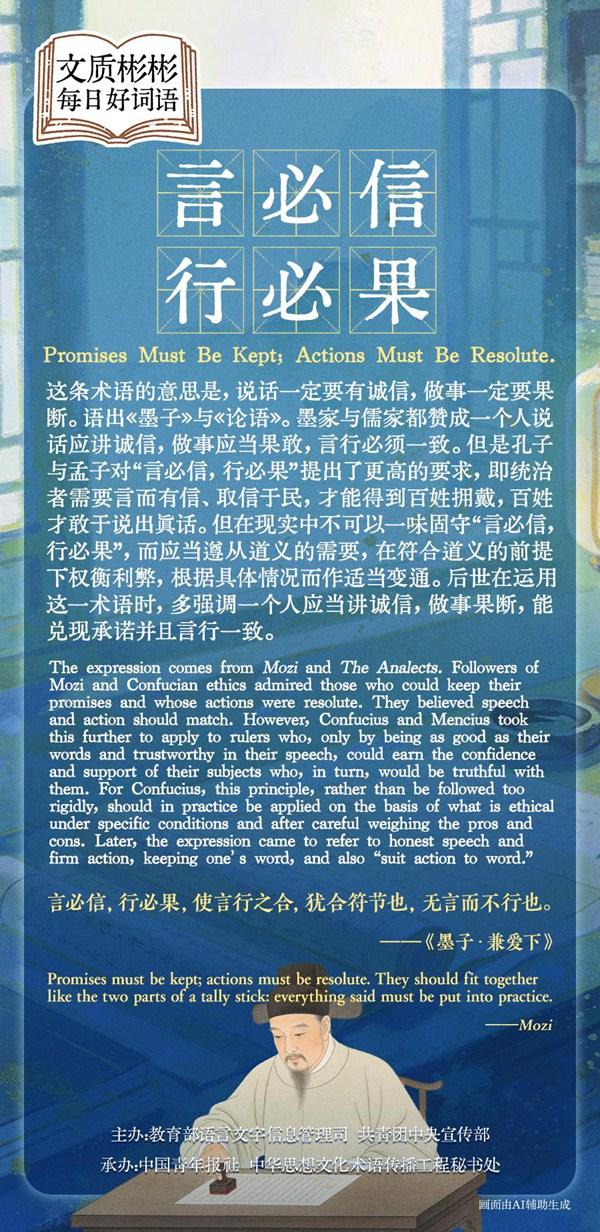
言必信,行必果
這條術(shù)語(yǔ)的意思是,說(shuō)話一定要有誠(chéng)信,做事一定要果斷。語(yǔ)出《墨子》《論語(yǔ)》。墨家與儒家都贊成一個(gè)人說(shuō)話應(yīng)講誠(chéng)信,做事應(yīng)當(dāng)果敢,言行必須一致。但是孔子與孟子對(duì)“言必信,行必果”提出了更高的要求,即統(tǒng)治者需要言而有信、取信于民,才能得到百姓擁戴,百姓才敢于說(shuō)出真話。但在現(xiàn)實(shí)中不可以一味固守“言必信,行必果”,而應(yīng)當(dāng)遵從道義的需要,在符合道義的前提下權(quán)衡利弊,根據(jù)具體情況而作適當(dāng)變通。后世在運(yùn)用這一術(shù)語(yǔ)時(shí),多強(qiáng)調(diào)一個(gè)人應(yīng)當(dāng)講誠(chéng)信,做事果斷,能兌現(xiàn)承諾并且言行一致。
Promises Must Be Kept;Actions Must Be Resolute
The expression comes from Mozi and The Analects. Followers of Mozi and Confucian ethics admired those who could keep their promises and whose actions were resolute. They believed speech and action should match. However, Confucius and Mencius took this further to apply to rulers who, only by being as good as their words and trustworthy in their speech, could earn the confidence and support of their subjects who, in turn, would be truthful with them. For Confucius, this principle, rather than be followed too rigidly, should in practice be applied on the basis of what is ethical under specific conditions and after careful weighing the pros and cons. Later, the expression came to refer to honest speech and firm action, keeping one's word, and also "suit action to word".
引例
言必信,行必果,使言行之合,猶合符節(jié)也,無(wú)言而不行也。(《墨子·兼愛下》)(說(shuō)出的話要守信用,做事一定要果斷,使說(shuō)的和做的能夠像符節(jié)一樣吻合,說(shuō)出的話沒(méi)有一句不去落實(shí)的。)
Promises must be kept; actions must be resolute. They should fit together like the two parts of a tally stick: everything said must be put into practice. (Mozi)
版權(quán)所有:中華人民共和國(guó)教育部 中文域名:教育部.政務(wù)
京ICP備10028400號(hào)-1 京公網(wǎng)安備11010202007625號(hào) 網(wǎng)站標(biāo)識(shí)碼:bm05000001




