整理/沈杰群 制圖/張玉佳
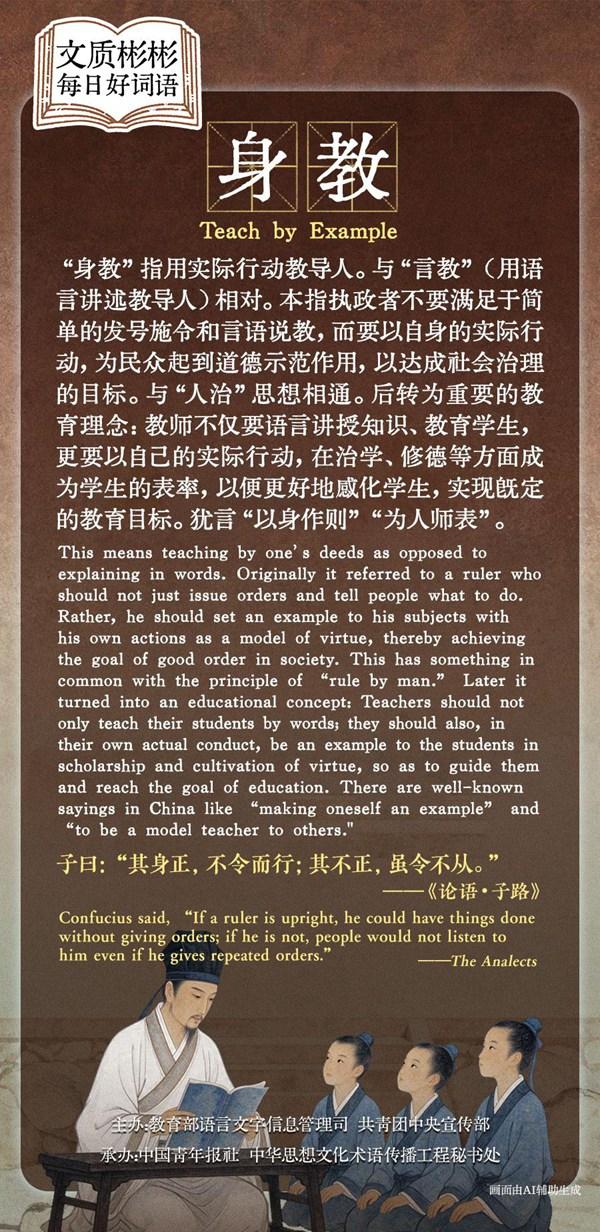
身教
“身教”指用實(shí)際行動(dòng)教導(dǎo)人,與“言教”(用語(yǔ)言講述教導(dǎo)人)相對(duì)。本指執(zhí)政者不要滿足于簡(jiǎn)單的發(fā)號(hào)施令和言語(yǔ)說(shuō)教,而要以自身的實(shí)際行動(dòng),為民眾起到道德示范作用,以達(dá)成社會(huì)治理的目標(biāo),與“人治”思想相通;后轉(zhuǎn)為重要的教育理念:教師不僅要用語(yǔ)言講授知識(shí)、教育學(xué)生,更要以自己的實(shí)際行動(dòng),在治學(xué)、修德等方面成為學(xué)生的表率,以便更好地感化學(xué)生,實(shí)現(xiàn)既定教育目標(biāo)。猶言“以身作則”“為人師表”。
Teach by Example
This means teaching by one's deeds as opposed to explaining in words. Originally it referred to a ruler who should not just issue orders and tell people what to do. Rather, he should set an example to his subjects with his own actions as a model of virtue, thereby achieving the goal of good order in society. This has something in common with the principle of "rule by man". Later it turned into an educational concept: Teachers should not only teach their students by words; they should also, in their own actual conduct, be an example to the students in scholarship and cultivation of virtue, so as to guide them and reach the goal of education. There are well-known sayings in China like "making oneself an example" and "to be a model teacher to others".
引例
子曰:“其身正,不令而行;其身不正,雖令不從。”(《論語(yǔ)·子路》)(孔子說(shuō):“執(zhí)政者自身行為端正,即使不下命令,事情也能順利進(jìn)行;自身行為不端正,即使三令五申,百姓也不會(huì)聽(tīng)從。”)
Confucius said, "If a ruler is upright, he could have things done without giving orders; if he is not, people would not listen to him even if he gives repeated orders." (The Analects)
版權(quán)所有:中華人民共和國(guó)教育部 中文域名:教育部.政務(wù)
京ICP備10028400號(hào)-1 京公網(wǎng)安備11010202007625號(hào) 網(wǎng)站標(biāo)識(shí)碼:bm05000001




