
整理/沈杰群 制圖/張玉佳
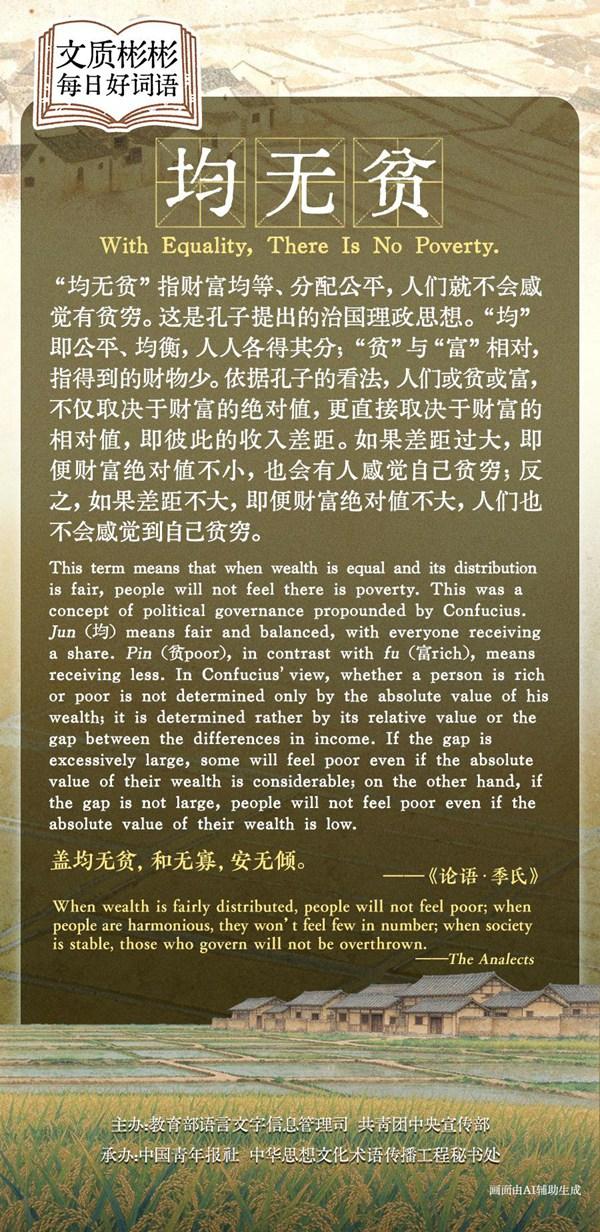
均無貧
“均無貧”指財富均等、分配公平,人們就不會感覺貧窮的存在。這是孔子提出的治國理政思想。“均”即公平、均衡,人人各得其分;“貧”與“富”相對,指得到的財物少。依據孔子的看法,人們或貧或富,不僅取決于財富的絕對值,更直接取決于財富的相對值,即收入差距。如果收入差距過大,即便財富絕對值不小,也會有人感覺自己貧窮;反之,如果收入差距不大,即便財富絕對值不大,人們也不會感覺到自己貧窮。
With Equality, There Is No Poverty
This term means that when wealth is equal and its distribution is fair, people will not feel there is poverty. This was a concept of political governance propounded by Confucius. Jun means fair and balanced, with everyone receiving a share. Pin, in contrast with fu, means receiving less. In Confucius' view, whether a person is rich or poor is not determined only by the absolute value of his wealth; it is determined rather by its relative value or the gap between the differences in income. If the gap is excessively large, some will feel poor even if the absolute value of their wealth is considerable; on the other hand, if the gap is not large, people will not feel poor even if the absolute value of their wealth is low.
引例
蓋均無貧,和無寡,安無傾。(《論語·季氏》)(財富均等就不會感覺貧窮存在,和睦相處就不覺得人口寡少,社會安定就不會發生政權傾覆。)
When wealth is fairly distributed, people will not feel poor; when people are harmonious, they won't feel few in number; when society is stable, those who govern will not be overthrown. (The Analects)
版權所有:中華人民共和國教育部 中文域名:教育部.政務
京ICP備10028400號-1 京公網安備11010202007625號 網站標識碼:bm05000001




